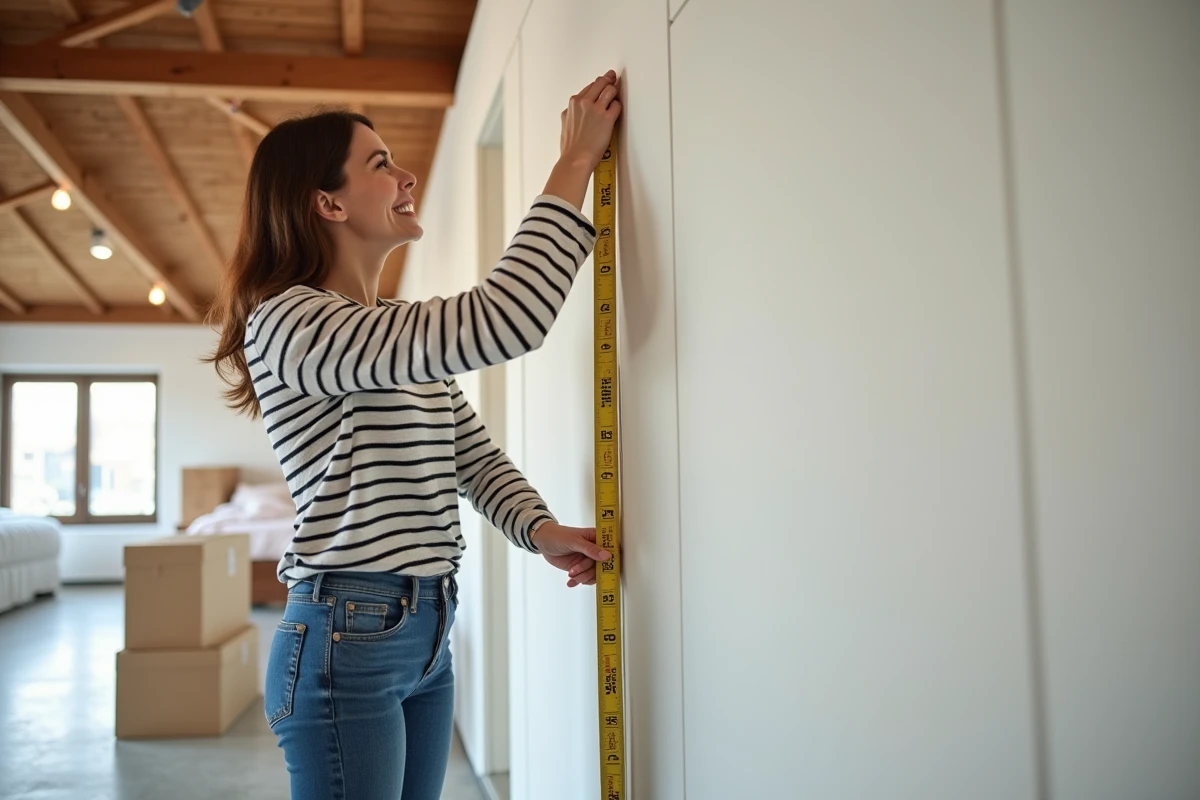
Multiply the height by the width, that’s a trick that fails as soon as the first slopes appear. Deviating walls, angled windows, or attics full of absurd angles shatter the basic calculation. Gone are the rough estimates: now, measurement applications and digital tools change the game on construction sites. Specialists rely on them to estimate in just a few minutes, even on the least regular surfaces.
Why the surface of a sloped wall does not allow for improvisation
A straight wall deceives no one. As soon as the slope comes into play, approximation becomes the worst enemy of the site: errors inflate bills, generate supply shortages, and delay timelines. With a crooked wall, it’s no longer enough to measure by eye; every detail requires method and rigor.
To move forward without stumbling, the strategy is as follows: break down each section into manageable shapes. Here are the markers that facilitate the organization of the calculation:
- First, distinguish the rectangles, the basis of the measurement, those on which it’s easy to place a tape measure.
- Identify the triangles, signatures of attics and sloped roofs.
- Spot the trapezoids or unique angles hidden in the mansard areas or under the rafters.
Once all these shapes are identified and measured, their areas must be added together and then the areas of the openings subtracted accurately. For detailed calculations, the best resource remains how to calculate the surface of a wall. This guide breaks down each step, from the simplest case to the most complex sloped walls.
Forgetting a recess or underestimating a dormer invites extra costs to the project. With meticulousness, one can avoid unpleasant surprises when ordering materials.
Proceed step by step for a sloped roof without unpleasant surprises
Neglecting a precise measurement of a sloped roof compromises the entire project from the start. The method remains uncompromising: start with the ground distance, then continue with the elevation of each segment of the roof. One inaccurate figure, and the estimate or schedule can collapse.
To lay the groundwork, follow these different phases:
- Take the exact measurement of the horizontal distance (D_H) as well as the elevation (ΔZ) of each sloped section.
- Calculate the slope using the formula: (ΔZ / D_H) × 100.
- Apply the Pythagorean theorem to find the actual length of the slope: L = √(D_H² + ΔZ²).
- Multiply this length by the width of the segment to obtain the specific area.
When roofs combine slopes and interlocking sections, each part must be isolated and treated with care. The slightest forgotten or overestimated area risks derailing the implementation from the very first day of installation.
Even experienced craftsmen do not hesitate to consult a seasoned colleague if in doubt about a measurement. A few checks are worth avoiding a redo of the site or additional deliveries.
The equipment and simulators that change the game
Some equipment transforms the measurement of sloped surfaces into a reliable exercise. Essential to have on-site: a well-calibrated tape measure, a spirit level, or even better, a laser level that ensures impeccable accuracy; not to mention the clinometer to measure the angle or slope. These tools are particularly important in renovations, where the straight wall is no longer the norm.
The principle remains to add everything together and subtract the openings and recesses, without neglecting anything. Too much caution never costs as much as an estimation error. Taking the time to verify each figure preserves both the budget and the quality of the result.
Additionally, online simulators speed up the calculation phase. Enter your measurements, adjust as needed, and validate the obtained area: a modern way to control your measurement, without neglecting vigilance on-site. The ideal is to combine concrete measurement with digital verification.
Precision of tools, calculation logic, and online control: these three pillars are enough to construct a sloped wall without unpleasant surprises. No chaos or unforeseen events in the estimate, every material finds its rightful place, and the project progresses steadily, section by section.